Monday, February 11, 2008

Wings Magazine

I'm pleased to announce that this month's issue of Wings Magazine features a blurb about "So, You Want to be a Pilot, Eh?"


The book is mentioned on page 12 in the "On the Web" section of the book. I'm quite flattered as Wings is Canada's National Aviation Magazine. It's a great source of information about the industry. On top of the magazine, the website is very informative to keep you up to date on what's going on in the industry. Right now, there's even a free trial to sign up for an online digital version of the magazine. Regardless, a good ol'paper subscription is worth the $34.00 a year.

Although, I did have to laugh a bit. This month's issue came with an insert for luxury cars. Although at the higher levels of the industry this would be valuable, on a flight student's (or in my case - law student's) salary (read - debt) it will be a number of years away!

Sunday, February 10, 2008

Seneca College Aviation

In my book, So, You Want to be a Pilot, Eh? I outline the general pros and cons of doing your flight training through a traditional flight school as compared to an Aviation College or University program. What I don’t outline are the pros and cons of specific College and University Aviation Programs. The reason for this was two fold: first, there are a large number of different programs and outlining them in a book would take up a lot of space and second, the programs are often changing and the information in a book would be out of date before the book even hit the shelves. On this blog however, I will attempt to touch upon different attributes of some of the aviation programs at Canadian Colleges and Universities.

If you have a particular program that you would like information on, please send me an e-mail and I will attempt to find out information about that particular program. As well, I would very much appropriate any readers who have attended various College or University Aviation Programs to send me an e-mail and share your experiences about your particular college.

This entry will be about my Alma Mater – Seneca College.

Seneca College’s Aviation Program was the first Community College Aviation Program in Canada and the program has been around for almost 40 years. In 2003, after the Ontario Government permitted Colleges to grant degrees for certain programs, Seneca switched it’s 3 year Aviation and Flight Technology Diploma to a 4 year Bachelor’s of Applied Technology Degree. It is a subsidized program (so are Sault College and Confederation College), however, with the switch to a degree, the overall price has increased and although it is less expensive than most combined flight training and degree programs, it is more expensive than the other subsidized programs in Ontario.

Here are some things to consider:

Fleet: While it is debateable, in my opinion, Seneca has, by far, the best fleet of training aircraft in Canada. The fleet consists of 7 new Cessna 172s, at least one of which has a full screen Garmin moving map display, 5 F33A Beechcraft Bonanzas and 2 Beechcraft B58 Barons. There are also 4 sophisticated simulators - 1 each for the 172, Bonanza and Baron and a Level 5 Bombardier CRJ 200 Regional Jet Simulator. While I am not sure about the newer simulators, when I was there, students had unlimited free access to these simulators. Free access to these simulators not only allowed students to practice their IFR and emergency procedures as much as they wanted, 25 of these hours can be counted towards the ATPL.
Seneca's Fleet

The CRJ 200 Sim

Location: Seneca is the closest full college, subsidized program to Toronto. This can be a good thing and a bad thing for both student life and flight training.
Buttonville Airport - East of Hwy 404 and just North of Hwy 407

For Student Life, if a student is from the Toronto area, there is the potential to live at home and commute to school. This is what I did. While it made for not quite as fun a College experience, it definitely ended up being cheaper in the long run. However, for students from outside of Toronto or who don’t want to commute, living in or near Toronto can be quite expensive. As well, due to the location of Buttonville airport, it is necessary to have access to a car as public transit to the airport is almost non-existent.

For flight training, it can be very beneficial to get used to working in some of the busiest airspace in Canada. While it’s a lot to take in at first, getting comfortable dealing with lots of traffic, different radio frequencies and different types of air traffic can improve your multi-tasking skills. On the other hand, it can make for a more stressful initial learning experience. Sometimes dealing with lots of different traffic when you’re just starting out can be quite overwhelming. Training in areas with less traffic can allow you to focus on the basics without having to worry so much about busy airspace. Personally, I enjoyed flying in that area, but I know others who would have preferred flying in a less busy locale.

Program Academics: As mentioned, Seneca’s program is now a 4 year Applied Degree. It includes a Co-op requirement and students are also required to maintain a minimum C+ in each course in order to continue on. Unlike when I went through the program, there is no longer a ‘cut’ after the first year where a certain amount of students are required to withdraw if they were not in the top 37.

I am a strong proponent of having a degree. However, one thing to keep in mind with Seneca’s Degree is that because it is an Applied Degree, it may not be afforded the same respect as a traditional Bachelor’s Degree from a University. If someone decided that they wanted to continue on in their education and complete a Master’s Degree or a professional degree such as Teacher’s College or Law School, depending on the school they’re applying to, they may or may not be accepted. I’ve been hearing stories that while some Universities gladly accept an Applied Degree as equivalent to Degrees from a University, other Universities refuse to accept these degrees.

I have mixed views about the Co-op program. While getting experience in the industry is always beneficial, from what I’ve been hearing from current students, the program itself is not quite as well structured as one would hope and for the most part, students have to find the employment themselves. There have been a range of positions, many of which are simply working the ramp with local airlines. This can be good in the fact that you gain experience and connections, but in the context of flight program, it might be more beneficial to get the flying done first so you can get into the industry quicker.

However, having students work prior to graduating may help to decrease the assumption of the Seneca ‘attitude’ –more on that shortly.

Program Expenses and Time: Tuition expenses work out to roughly $10,000 a year. Tuition per semester is roughly $3500 and you also spend a summer semester flying. While $40,000 for a 4 year Degree is not cheap, compared to the regular cost of flight training or a degree program, this is a real bargain. However, when you compare this to the other two subsidized Ontario Colleges – Confederation and Sault College, their total costs are significantly lower due to the fact that they are still Diploma programs and the actual length of the program is shorter.

4 Years is can be a long time to do all your flight training. I felt that a 3 year program was still a little too long, adding on an extra year is another year that you could be flying and getting experience in the industry. There are many pilots who feel that the best thing to do is get your training done as quick as possible so you can be out in the industry getting experience. If someone rushed through their training in a year or two, then worked the ramp for 6 months to a year, they could still have 2000 hours in the same time it took to complete a 4 year degree.

I think having a degree, other education and a College experience are all very important things, but for someone who wants to get flying as quick as possible, Seneca is probably not the best choice.

Jobs: Overall, Seneca has a very good reputation in the industry in Canada. It is a well established, comprehensive program that airlines respect. Having a Seneca Degree will bode well for when you have enough experience to be applying to Airline jobs such as Air Canada. That being said, many of the other established Aviation Diploma programs in Canada are afforded that same respect. As well, having a Bachelor Degree in another discipline can also be valuable.

At the lower levels of the industry, a Seneca Degree will not necessarily help you get a job. In fact, there are a number of ‘bush’ types who feel that Seneca graduates are all ‘city kids’ who don’t know how to do a solid day’s work. Some graduates with an attitude have tainted the reputation. While I will be the first to admit that I have met a few grads who think that they are God’s gift to aviation, I’ve also met numerous other pilots (not from Seneca) who have that same attitude. The vast majority of my classmates and other Seneca grads I’ve met have been awesome folks. If you do graduate from Seneca, just be aware that you may need to go that extra step to prove that you’re not a jerk and you can put in a good day’s work.

The fact that Seneca’s program has been around for so long means that it has a lot of alumni working at many different airlines across Canada and the World. Having this type of networking possibilities can be very beneficial.

Finally, Air Canada Jazz tried a pilot program last year where top grads from Seneca and a number of other colleges were interviewed and successful candidates were offered spots in ground schools for potential First Officer positions. This program is not without controversy and it remains to be seen if it will be successful.

Conclusion: I enjoyed my time at Seneca and they really do have a great program. The fleet is great! In fact, you likely won’t fly on such nice and well maintained planes for a number of years when you actually start working! For students that want a degree, want to live near Toronto and want to get first rate flight training, Seneca is a great choice!

Saturday, February 9, 2008

When Flight Schools Go Bankrupt

A large helicopter flight training school in the US, Silver State Helicopters recently ceased operations. Here's an article from the latest AvWeb News Flash


Students Left Hanging By Silver State Closure

Shocked by the downfall of Silver State Helicopters, the Nevada-based flight school that declared bankruptcy earlier this week, former students and employees are telling AVweb they face major financial losses. Silver State Helicopters abruptly shut down operations at its 34 nationwide locations on Sunday afternoon, leaving more than 800 employees without jobs and more than 2,500 flight students saddled with millions in debt.

Company president and founder Jerry Airola has yet to speak publicly on the event, but a statement released by the company alleges that “a rapid, unprecedented downturn in the U.S. credit markets” curtailed the availability of student loans for the company’s students and resulted in a “sharp and sudden downturn in new student enrolment.”

Tony and Heather Sullivan told AVweb they were at a Super Bowl party when they got the news. Heather was employed as a receptionist and flight dispatcher at Silver State’s Houston facility, where her husband was a student. To date Tony has logged just 81 of the 200 hours he signed up to receive, and said he does not know how he is going to complete his training. Tony, who works full time as a human resources manager for a construction company, said he has an outstanding loan through American Education Services (AES) for approximately $70,000, the cost of the 18-month program designed to get students through their private, commercial, instrument and initial flight instructor certificates.

Mike Reiber, spokesperson for AES, told AVweb that AES is one of several companies that originated and serviced loans made to Silver State students. “Effective this past Monday we are no longer dispersing money to Silver State Helicopters,” he said. “Any disbursements that were sent out are being returned.” Reiber said that AES is awaiting direction from Student Loan Xpress, the guarantor of the loans. Student Loan Xpress spokeswoman Jenn Stark said Silver State should pay unused tuition back. “As a result of Silver State Helicopter School's decision to file for bankruptcy protection, we are currently working with its students to ensure that their loans are managed properly until the bankruptcy court decides upon a course of action to assist them." she wrote in an email to AVweb. She said affected students can contact Student Loan Xpress for information, at 888-568-2429, between the hours of 8 a.m.-5 p.m. EST.

Silver State Helicopters is a member of the Helicopter Association International (HAI). In an undated membership profile on HAI’s website, Silver State lists a fleet of 195 helicopters including 138 two-place Robinson R22s and 43 four-place R44s. HAI president Matthew Zuccaro told AVweb that the loss of such a large flight school will be felt throughout the industry. “It’s certainly of concern to us,” he said. Jerry Airola founded Silver State Helicopters in 1999 and quickly became known throughout the industry for using aggressive sales tactics to recruit students to the program.


One of the biggest problems is that many students had paid in advance for the courses. Therefore, not only do they now not have the cash, but if they want to complete their training, they'll have to invest extra as even if they do eventually obtain some of their loans back, it will likely be a fair amount of time before this occurs.

It is generally a bad idea to pay in advance for your flight training. Sometimes it's unavoidable due to the nature of the program - e.g. a college program, but you should be wary of what you invest.

This type of thing has happened in Canada. In 2001, Advanced Flight Training Centre in Barrie, Ont went out of business. At the time, the provided flight training for any students who wished to pursue the flight option in conjunction with Georgian College's Aviation Management Program (Georgian since has a new flight training provider). Numerous students lost thousands of dollars each. In fact, the operator of the flight school was charged with 22 counts of fraud and 22 counts of theft. Recently however,the charges were stayed (meaning that she would no longer be prosecuted) because of the delay in having the matter come to trial.

Be careful where you invest your hard earned training dollars.

Sunday, January 27, 2008

Jetstream

The Discovery Channel in Canada has an interesting show that's running in January and February with episodes first airing on Tuesdays at 10 pm EST with repeats throughout the week. The show is entitled Jetstream and it is about Air Force pilots training on the CF-18.


Overall the show seems really well put together. There's some good special effects, great scenery and they show some pretty good detail about the type of training that's required for military pilots to make the transition from the Hawk jet trainer to the CF-18 Hornet. It's Intense!

I have a couple minor complaints in that they try and "Top Gun" things up to make the show a little more suspenseful, but overall, I highly recommend it for anyone interested in flying, especially in a career with the Armed Forces.

Saturday, January 26, 2008

Gimli Glider Retired

On Thursday, Air Canada retired a Boeing 767-200 with the registration C-GAUN and the tail number 604. This wasn't any old 767, this was the famed Gimli Glider which ran out of fuel and managed to land safely in Gimli, Manitoba after gliding from 40,000 feet.

Here's a video of the 767 doing a flyby at Montreal's Trudeau airport before heading south to the Mojave desert.


This is an article from CBC News

Pilots, crew reboard 'Gimli Glider' for final flight
Last Updated: Thursday, January 24, 2008 | 2:09 PM CT
CBC News

The two pilots and several crew members who safely landed the legendary "Gimli Glider" are boarding the plane again Thursday as it makes what could be its final flight.

Pilot Robert Pearson and his first officer Maurice Quintal will board the Air Canada Boeing 767 in Montreal to oversee Thursday's flight, which will carry it to its new home at California's Mojave Airport.


An Air Canada Boeing 767, nicknamed the Gimli Glider, dwarfs race cars using the Gimli, Man. abandoned airstip as a race track in this July 24, 1983 file photo.
(The Canadian Press/Winnipeg Free Press/Wayne Glowacki)

"Four groups … have shown some interest in acquiring the airplane, either for flying test beds for engines or for museum purposes, so it may not stay there too long," Pearson said.

"Hopefully somebody will find a use for it."

Three of the six flight attendants who were on Flight 143 will also be on board Thursday.

In July 1983, Flight 143 was on its way to Edmonton from Montreal when it ran out of fuel 12 kilometres above the Ontario-Manitoba border.

The 120-tonne plane, worth $40 million, became a glider, dropping over 600 metres per minute with no hope of reaching Winnipeg.

Pearson and Quintal managed to glide the plane, which had 61 passengers and eight crew members on board, 200 kilometres and then land it at an abandoned military airstrip in Gimli, Man., located north of the Manitoba capital on the shores of Lake Winnipeg.

The day of the accident, the Winnipeg Sports Car Club was holding a "Family Day" at the old Gimli base, so it was filled with families and campers and the runway was being used as a race track. Spectators and racers had to scatter as the giant plane touched down, then put out a fire in the nose with hand-held fire extinguishers.


None of the passengers was hurt during the landing, although some sustained minor injuries while using the plane's rear emergency slide.

After the landing, Pearson and Quintal were praised for their quick thinking. Pearson was an experienced glider pilot, while Quintal had once been stationed at the Royal Canadian Air Force base at Gimli and was familiar with the landing strips.

Later investigation revealed the plane was only carrying half the amount of fuel it required for the journey because of a metric conversion error that was made on the ground.

Months after the crash, Air Canada disciplined the two pilots for allowing the near-tragedy to happen. Pearson was demoted for six months, while Quintal was suspended for two weeks. Three ground workers were also suspended.

A 1985 Transport Canada report blamed the incident on errors and insufficient training and safety procedures.

Air Canada is organizing and paying for Thursday's reunion, but it won't comment on it.

Pearson said he doesn't think any airline likes publicity about accidents, even if they narrowly avert tragedy.

Thursday, January 10, 2008

The Cost of a Medical

Commercial Pilots in Canada have to undergo a medical examination once a year (twice if they're over 40) as well as a number of other tests including an ECG and hearing tests at different intervals.

The Class 1 medical is required to fly commercially in Canada. However, it reverts back to a Class 3 medical if you don't renew it within the 12 months. A person holding a Class 3 medical can exercise the privileges of a Private Pilot, but cannot fly commercially. Because I've been in school I haven't kept up my Class 1 medical, however, I recently decided to renew it.

This is a post I posted on AvCanada recently:
Living in a new city without flight benefits, I went searching for a new Medical Examiner so I could renew my medical.

I lucked out and found one at the medical building that's just a couple blocks away. Sweet! I'll be able to walk there. I booked an appointment and after getting everything sorted out the receptionist reminded me that if I missed the appointment I'd get charged $50 the next time for a missed appointment (Seinfeld anyone?) I quickly asked at the end of the phone conversation how much the medical would cost. "$150" was the reply and then she politely, but quickly, hung up on me as she switched to answer another call on her busy swtich board.

$150! It had been a few years since I had my last medical. Wow, I thought. Prices must have gone up quite a bit. But something wasn't sitting right. The most I had ever paid was $120 or so and that was in Expensive Toronto and with a doctor whom I had been going to for all my medicals. I also searched AvCanada and found inferences of people paying far less.

Back to the CAME database on TC's website. I found another doctor relatively nearby and gave them a call.

"How much for an aviation medical?" I asked.
"$75" was the reply.

I was surprised at the difference.

Having a doctor that you trust and can help keep you flying is an asset. However, having one doctor charge twice as much for a medical than another is pretty crazy if you ask me. While cheaper isn't necessarily better, that's a pretty big difference in price.

So, how much did you pay for your last medical?


The post was accompanied with a poll on what other pilots had paid for their medical. The results as of this blog post were:


The price can vary quite drastically. While I don't suggest that someone should go to a doctor simply because they are the cheapest around, it pays to look around a little bit. Also be sure to ask other pilots about which doctors they've been to and what their experience has been.

Sunday, December 30, 2007

Back in the Day: Part IV

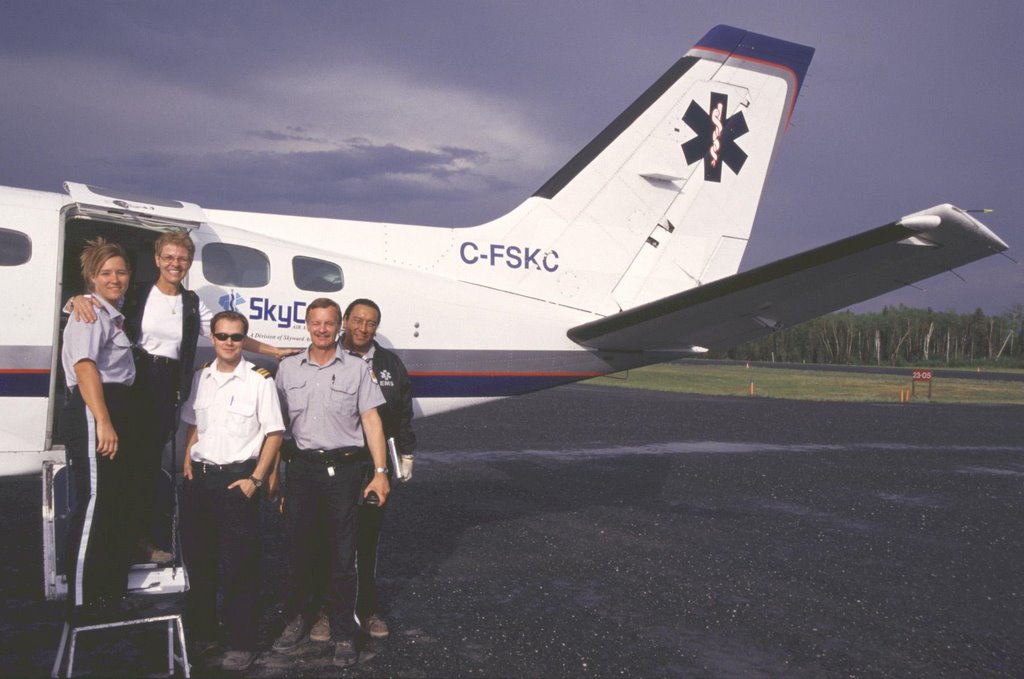
This was the fourth mass e-mail that I sent out. I had spent the summer flying medevacs and it was just a couple of weeks before my stomach started giving me troubles. Although I worked a lot that summer, it was a great summer. I got to go to Switzerland in June and was able to enjoy lots of outdoor activities in Thompson.


Yesterday, August 23rd, marks two anniversaries. Meaningless and inconsequential in the grand scheme of things, however, it is still an interesting thing for me to stop and notice. It is my 2 year anniversary working at Skyward and my 9 month anniversary of flying for them.

If at the end of high school, someone were to say to you me that I'd be living over 2 years (right now with the way the industry is going it looks like it'll be probably around 4 or 5 total) of my life in a small town in Northern Manitoba, I would have thought they were crazy. WHY would anybody want to live there? However, here I am. I as of yet do not own a pick-up truck, a rifle, a snowmobile jacket and I won't ever grow a mullet. I have discovered a taste for country music, developed my 'Manitoba' accent and while I like to joke that I have lost my ability to successfully use words longer than 4 syllables in most sentences, I have found a new appreciation for a way of life that is different than the general hustle and bustle of Toronto.


Last week, Sara, a new flight nurse and also a pilot moved to Thompson from southern Ontario. It's been really great talking to her as I remember all the same reactions that I first had when I got up here. "I can't believe the amount of unsupervised children running around everywhere", "I've already decided to stop playing fashion police up here". It's humourous, but a little sad at the same time. I've been super lucky that I've been able to keep in touch with most people via e-mail and MSN and have been able to get home a lot. As long as you're not stuck there for months on end, Thompson can be a nice little town.

The INCO mine with the City of Thompson in the background
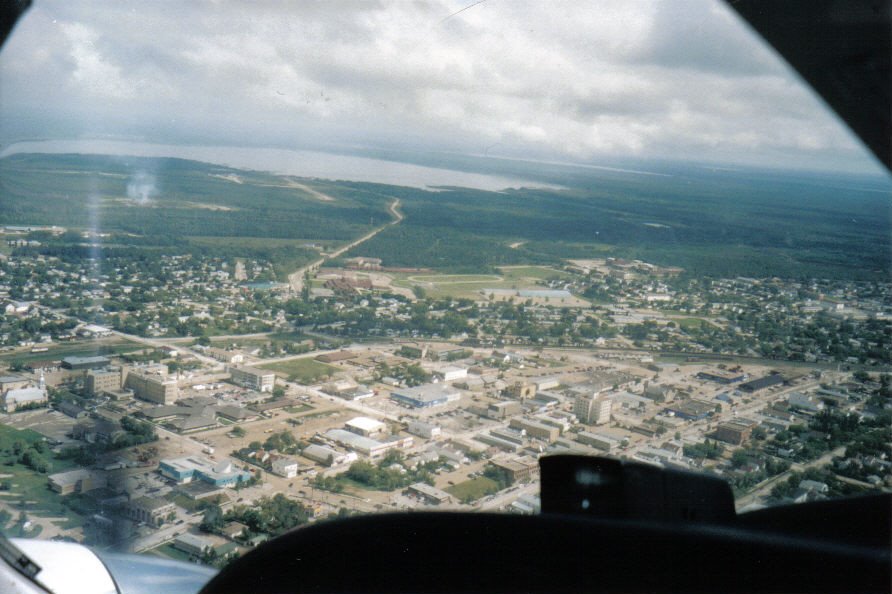
The flying has been going really well. Time has flown by since I started (sorry for the bad pun) as I'm finally doing what I came up here to do. My record of longest time working on the ramp has been broken and there will be guys who will have to do 2full winters loading cargo. I am one of the lucky ones.

Medevacs themselves are very interesting. Not something I'd ever thought I'd be doing. Today we had two trips to two different reserves, both to pick up guys who had had the crap beaten out of them. There are usually more fights right around the 20th and the 1st of the month because that's when the family allowance and welfare cheques come out. More money in town, means more sneaked in booze, meaning more business for Medevacs.

A few weeks ago we had a Medevac from Pukatawagan to The Pas. It was a psych patient so we took along an RCMP officer in case the patient refused to go, that way he could be arrested under the mental health act. This patient actually behaved really well, even said “Please” and "Thank you" when talking to the nurse and RCMP officer. On the way to The Pas, the officer asked if after we dropped off the patient, we'd be able to go visit the jail, as it was their brother in-law's first day. “Sure!” we replied, “is he a guard?” 'No' the officer responded, he's in jail and it's his first day. We weren't quite sure what to say to that, but they still ended up having a nice visit, after which the guards gave us a great tour of the place. I had never actually seen the inside of a jail before. It wasn't too bad, but not a place I'd like to spend any time.

Pukatawagan


The Pas


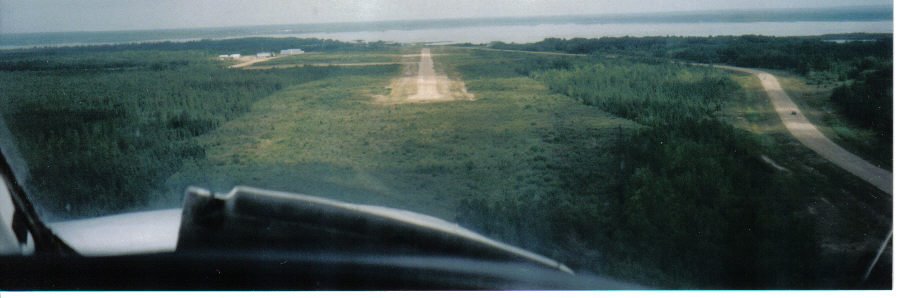
A couple days later, my roommates, Geoff (a Captain) and Paul (a nurse) and I had a midnight Medevac to Shamattawa. It was an overcast night, there were no moon or stars, and it was very dark. Shamattawa is very isolated, a few hundred miles south of Churchill. In October of 2001,on a very similar night, a Perimeter airlines Medevac plane crashed after doing an over shoot on the runway in the 'black hole' conditions killing both pilots and seriously injuring the flight nurse. We made note of this in the pre-landing briefing. As we got closer to the field and switched the runway lights on, we noticed that the front third and last third of the runway lights were working, but the middle lights were all burnt out. We could still see the outline of the runway clearly and decided it was safe to continue on with the approach. The approach was smooth, the winds were quite light so I didn't have a very strong cross wind to fight. Right in the flare, our landing lights revealed why the middle runway lights were out. Some kids had vandalized the runway, smashed the lights and left them and the pylons that hold them right in the center of the runway! Right where I was going to land. We still had enough speed so we were able to hop around them and then come to a stop with a fair amount of room left on the runway. But still, that's not something you are expecting to have to deal with when landing a plane. And really, if you live in an isolated community where airplanes are the only way or in out, do you think vandalizing the runway and possibly causing an accident is a smart idea? Geez, there really are some dumb people in this world, plus I’m willing to bet at some point one of them will have to be Medevac’d out making use of the same runway they vandalized.

Last weekend I had the most exciting Medevac of my career so far. It was already a busy night in at the Thompson hospital as a little girl and her mother were hit by a car while crossing the road. The driver was blinded by the sun and didn't see them until it was too late. Originally, Life Flight, the gov't of Manitoba's jet was supposed to take the little girl, and we were to take the mother. Sadly, the little girl ended up dying from her injuries, so they decided to keep the mother in Thompson for a little while longer. We ended up getting the patient from hell.

This guy, (only 20 years old) was easily about 6'4" 280 lbs and had just got out of prison a week before (not the same one I visited). I guess he tried to go settle some old debts after having lots to drink, but ended up getting the crap kicked out of him. He was found unconscious by the side of the highway. By the time we loaded him on to the plane he still reeked of alcohol even though it had been almost 20 hours since he had been drinking. He was barely conscious, but just to be sure his wrists and ankles had Velcro cuffs on them. He was difficult to get through the door cause he was so tall and quite heavy, however, since he barely had his eyes open we didn't figure he would be much of a problem. We got a quick glimpse of things to come when just before we took off, he bolted himself up to an upright sitting position and started screaming. The nurse settled him down, told him that we were just going to a hospital in Winnipeg and that he should just try and sleep for the trip. The doctor we took along with us didn't even wake up for it (probably because he was narcoleptic). The patient laid back down, and we blasted off for Winnipeg.

After we were about half way there (An hour and a half flight), the patient sat up and started screaming again, he was harder to calm down, the nurse managed to, but only for about ten minutes until this guy started screaming again. We woke up the doctor who went to go help the nurse hold down the patient. The doctor held him down by the C-collar on his neck, but the patient was so strong that he sat up really quickly and broke it. The doctor then held the patient down by his shoulders.. He was screaming and swearing more, and then he started spitting. This was made even more unpleasant when added to the fact that he had lots of cuts in his mouth so his spit was bloody. He managed to hit the doctor with some. The Doctor, a big man and ex Olympic class Judo competitor didn't appreciate being spit on. He then took a blanket and covered the patient's mouth to keep the spit from going everywhere. This may sound harsh, but when you consider the potential for serious communicable disease, I felt the actions were justified. Even still, after everything was done the ceiling of the plane was covered with bloody spit. The doctor didn't want to give him a sedative because we didn't know if he had brain damage or not. About 20 minutes before landing, the nurse said he was having real trouble with the patient trying to get out of his restraints, and unloading him was going to be next to impossible. We called ahead to Winnipeg and asked them to call the police to meet us after landing.

When we arrived, The airport police were waiting for us. We asked if they had any restraints to help unload the patient, but they said they didn't. I asked the maintenance guys that showed up to watch if they had any cargo straps, they said they did and we went to grab them. When the police were told about the spitting patient, they offered to get us a 'spit sock' for him. This is a mesh bag that you put over his face and when he spits, it doesn't go through. It took a bit of time, but once we had the patient herc strapped down, a spit sock on him, 2 pilots, a doctor, a nurse, 4 police officers, 2 paramedics and a bunch of mechanics, we were able to unload the guy. We had breakfast in Winnipeg, flew home, then went to bed, exhausted.

I'm sure I'll have more stories like these as time goes by.