Showing posts with label Flying Stories. Show all posts

Wednesday, August 6, 2008

Ah, the joys of flying.


I’m currently in seat 15A of an Air Canada 767-300 (without the new interior). I’ve already finished the book I brought to read and don’t feel like starting another one at the moment.

When I was younger, flying as a passenger on an airliner used to be more fun than the actual vacation itself. Now, things are not quite as fun, however, there’s still something to be said for air travel. In this situation, this flight is bringing me back home away from the unpleasant sprawling urbanity that is Canada’s largest city.

The flight was delayed. The Thunderstorms started about an hour and a half before we were scheduled to depart. The ‘strobes’ at Pearson were flashing when I made it to the boarding lounge. That meant that lightening had been reported in the vicinity and ground personnel were not permitted to work on the ramp. This meant no loading or unloading of bags, no marshalling of aircraft, no fuelling. The airport essentially comes to a stand still.

Despite the fact that we boarded the plane at the proper time, once everyone was seated, we got an announcement that there would be a 15 minute delay for push back. After about 20 minutes, it was announced that there would be further delay as there had been a problem with getting the plane unloaded and loaded. After about 45 minutes of waiting at the gate, we got push back, after which time the Captain (poor guy) informed us that there we were roughly #20 for take-off. There was a collective groan from the passengers and on cue, that’s when two babies started loudly crying in stereo. We made the slow trip up taxiway Alpha. At least I got to watch the departing aircraft out the window as they were using 15L for departures.

An hour and 45 minutes later we were airborne. We got a spectacular view of the different layers of clouds with the sunset peeking through at various times. The post take-off announcement was made and included the apology that the main screen for the inflight entertainment wasn’t working this particular flight. The passenger next to me and I shared a good laugh.

This post is not meant as a rant. The Air Canada employees have acted professionally despite the fact that they are Halifax based flight attendants and they’re facing a base closure as of Nov 1st. The passengers have been pretty good as well. Although there was general disappointment about taking off an hour and 45 minutes late for a 2 hour flight, there was no self-righteous idiot demanding that the plane leave, in the middle of a thunderstorm, because the business meeting she needed to get to the next morning was so important. But still, it’s tough. Dealing with the realities of the airline system today can be quite frustrating. There are certain aspects where you have to think “this could be done better” – either more efficiently, more comfortable for the passengers or better for the environment – but getting upset about it doesn’t do much.

We’ve started our descent into Halifax so I’ll finish off this post. It’s still been a fun experience, but travelling as a passenger, or a crew member on the airlines today requires a large helping of patience.

Tuesday, May 20, 2008

To Go, or Not to Go - That is the Question


I returned from a much needed vacation on the weekend to find that my most recent issue of Flying Magazine had arrived in the mail. I quite enjoy reading Flying. Although it is an American publication, most of the articles are very interesting and relevant to non-US aviators. As well, being able to briefly ignore the fact that I owe lots of student loans, their aircraft reviews allow me to dream about what aircraft I'll purchase when I'm independently wealthy - whenever that happens. It's funny, I'm not that into buying 'stuff', but I sure would love to own an airplane.

One of the articles this month was No, No, I Won't Go by Tom Benson. It outlines Tom's decision of whether or not to make a trip in his own personal aircraft to have some scheduled maintenance work done. Tom makes some really interesting points on how to determine whether to go or not.

He states: The go/no go decision is an easy one to make when the conditions are so ominous that the choice is obvious. The hardest decisions occur when things "aren't that bad," "might improve" or "this isn't that much worse than the time I did it before." This quote hits the nail right on the head. When I was flying the C206 and C207 VFR doing charter work it was the days that were just on the cusp on being bad weather days that I hated the most. Especially when you have paying passengers who need to get to an important meeting, simiply deciding not to go because the weather is borderline is not always a good solution.

There is an oft used saying in Aviation "The hardest part about flying is knowing when to say 'No'"

So, when do you say 'No'?

In his article, Tom outlines some ways in which he decides if he wants to go or not - flipping a coin but then examining if that was the answer he wanted. Different things work for different people. I had a couple of different methods for deciding when to go or not (in a VFR scenario). If you're an experienced pilot and have other strategies I'd be interested to hear them in the comments section.

For me, the first thing I would do, if possible, would be to talk to the passengers. Let them know that the weather is so/so and there may be the possibility that we'd have to turn back, or it'll be really bumpy etc. Sometimes the passengers were fairly nervous flyers, so they'd decide that they didn't want to go.

As an aside, I once had a flight instructor who was flying corporate charters. He had a passenger that really really wanted to get to a meeting. Along the flight path however, there were some thunderstorms building up and the whole flight looked to be very turbulent. The passenger wanted to go anyways and threatened to take his business somewhere else if my instructor didn't do the flight. Right near the departure airport, the turbulence wasn't too bad. So, my instructor took off and then after leveling off, created some turbulence of his own by osillating the controls causing a very unpleasant ride for the passenger. After a couple of minutes, the passenger called to the pilot "you were right, this turbulence is really bad - let's go back!" While I don't necessarily recommend purposely trying to make your passengers sick, sometimes being a pilot requires you to find creative ways to say 'No'.

After checking with the passengers, I'd then go and look at my back up plans. The thing about flying is to always have 'an Ace up your sleeve'. I'd always be thinking about what my options were once I was in the air. If the weather got crappy at a particular point, what would I have to do to make it safely to the ground? Were there alternate airports near by? What's the terrain like? What's my way out? If I wasn't comfortable with those answers, that's when I'd say No.

There have unfortunately been many young pilots who didn't say No when they should have and they and their passengers paid the ultimate price.

Wednesday, May 7, 2008

Owning Up

In early November 2002, I had just found out that after working on the 'ramp' for 15 months loading bags, cargo, setting up seats and cleaning, that I would finally be moving up to a flying position as a First Officer on one of my airline's medevac Cessna Conquest II's. I was excited!

Working the ramp was a challenge and was hard work, but it was not what I spent 3 years in College training towards. I was training towards being a pilot. I still tried to do a good job though.

At my airline, cargo was a separate department. I was technically responsible for baggage, not the cargo. Although I did try and help the cargo guys load, there was often a lack of communication between departments.

One evening, after cargo had gone home, I was checking the aircraft to make sure they were empty. I noticed that there was still a big tool bag on the plane. "Hmmm, that's not right" I thought. There were no more scheduled departures that I knew about so I unloaded the bag and placed it in the cargo warehouse.

The next day I was chatting with a colleague on MSN Messenger. He mentioned that the other night there was an emergency charter flight by some workers from the Hydro company to a remote reserve that had lost all it's power. There were only two passengers and a bag of tools, but when they arrived at the destination, the bag of tools wasn't there. This was a very expensive charter and made the company look really bad. According to my colleague, 'heads were going to roll in cargo'.

After the conversation, I was thinking.
"Wow, that's not good, I thought ...... wait a second..... oh no..... oh CRAP!....I was the one who unloaded the bag!"

Now I had to figure out what to do. Although I had been the cause of the screw up, I didn't technically do anything wrong. The cargo and charter division did not tell me about another flight and I was supposed to check the planes before I left. But still, being just a week away from starting as a pilot, I didn't want to risk being fired. At the same time, I didn't want to risk having one of my friends fired.

I called the Charter Supervisor. I explained that I was the one that took the tools out of the aircraft. I approached it as simply explaining what I had been doing. I didn't try to make excuses, but at the same time I made it clear that no one had told me about this extra flight. Although she was upset, she knew that I was a good worker and that I wasn't being careless in doing what I did.

In the end, I made the right choice to explain what happened. In this situation it was going to be trouble if the proper explanation didn't get out. In many situations, covering things up will usually make the consequences worse. But still, in an industry like aviation, it can be tough to admit your mistakes when you screw up. It might not be necessary to try and recount every mistake you've ever made to someone else - Aviation is all about learning from your mistakes. But as a pilot, when something goes wrong, it is your duty to take responsibility for it.

Monday, May 5, 2008

Layovers

A couple of days ago I was lying on the beach at Platis Gialos in Mykonos, Greece. (Also the reason why I haven't blogged in a while)


While there, by fluke, we ran into another law student from Dalhousie. She was mentioning that earlier that day she had met some people on the beach who were corporate pilots based in Italy. They flew a private jet for the owner of a popular retail clothing line and they were currently relaxing on the beach waiting to fly him back. Must be nice!

The ability to travel and see interesting places is one of the biggest perks of being a pilot. Often, this travel takes place while you're essentially still working - a layover. To save money, airlines are generally reducing the amount of layovers pilots get, however, pilots still get to travel and spend a lot more time in distance places than the average person.

In his book, From The Flightdeck: Plane Talk and Sky Science, Doug Morris talks about a few of the interesting layovers that he's had. The most exciting of which is his trip to the Taj Mahal. These trips can be interesting and a great way to go exploring.

The pilot's life isn't all fun travel though. There are downsides to having layovers. You're often not able to travel with your signifcant other, your timeisn't necessarily your own, you're away from home and in reality, most layovers involve a lot of waiting around at various airport hotels not close to the action.

But still, getting paid to lay on the beach would be nice!

Thursday, April 17, 2008

Harrison Ford - Just Another Pilot

Found this video through a post on AvCanada. It's a neat little video about Harrison Ford who has his pilot licence. The difference between him and most recreational pilots is that he has piles of cash so he's able to "buy an occasional airplane." Regardless of the tinge of jealousy I feel, it's good to see that he enjoys flying and really outlines some of the great feelings of flying that are sometimes hard to put into words.


One other quick comment, although I didn't have my first solo in a 206, my first landing in one was similar to how he describes his. Because I had been flying a plane that had a lower landing attitude, on my first landing in the 206, I let the nose get to low and the nose wheel touched down first and I porpoised down the runway. After about 3 big bounces I added power and had my first overshoot in the 206!

Tuesday, March 18, 2008

Flying Exhausted

Just a quick follow up to the last post. There's a new thread on AvCanada about Flying Exhausted. They've included a poll the results of which as of March 18th, 2008 @ 7:28pm Halifax time were:

I have fallen asleep while flying before. There was another pilot and I had discussed with him that I was just going to close my eyes for a few minutes. In my opinion at least, it's better to be upfront with the other pilot about what you're doing. I felt I would be much safer if I had a short nap than if I struggled to stay awake.

I have also had it a couple of times where one of the Captains I was flying with fell asleep. He told me ahead of time that he was going to close his eyes for a bit, although he ended up sleeping for a couple of hours. I was alright with that though and the peace and quiet was nice. If there were any problems it would have been easy to wake him up and I didn't feel tired at all.

When I was flying the C207 as the only pilot, I did have one day where I had to fight very very hard to keep my eyes open. It wasn't late at night, but for whatever reason, I was feeling very tired. It was tough, but I turned on all the air vents, got cold air blowing, tried to sing to myself - anything to keep me awake. It worked, but it can be tough sometimes.

Saturday, January 26, 2008

Gimli Glider Retired

On Thursday, Air Canada retired a Boeing 767-200 with the registration C-GAUN and the tail number 604. This wasn't any old 767, this was the famed Gimli Glider which ran out of fuel and managed to land safely in Gimli, Manitoba after gliding from 40,000 feet.

Here's a video of the 767 doing a flyby at Montreal's Trudeau airport before heading south to the Mojave desert.


This is an article from CBC News

Pilots, crew reboard 'Gimli Glider' for final flight
Last Updated: Thursday, January 24, 2008 | 2:09 PM CT
CBC News

The two pilots and several crew members who safely landed the legendary "Gimli Glider" are boarding the plane again Thursday as it makes what could be its final flight.

Pilot Robert Pearson and his first officer Maurice Quintal will board the Air Canada Boeing 767 in Montreal to oversee Thursday's flight, which will carry it to its new home at California's Mojave Airport.


An Air Canada Boeing 767, nicknamed the Gimli Glider, dwarfs race cars using the Gimli, Man. abandoned airstip as a race track in this July 24, 1983 file photo.
(The Canadian Press/Winnipeg Free Press/Wayne Glowacki)

"Four groups … have shown some interest in acquiring the airplane, either for flying test beds for engines or for museum purposes, so it may not stay there too long," Pearson said.

"Hopefully somebody will find a use for it."

Three of the six flight attendants who were on Flight 143 will also be on board Thursday.

In July 1983, Flight 143 was on its way to Edmonton from Montreal when it ran out of fuel 12 kilometres above the Ontario-Manitoba border.

The 120-tonne plane, worth $40 million, became a glider, dropping over 600 metres per minute with no hope of reaching Winnipeg.

Pearson and Quintal managed to glide the plane, which had 61 passengers and eight crew members on board, 200 kilometres and then land it at an abandoned military airstrip in Gimli, Man., located north of the Manitoba capital on the shores of Lake Winnipeg.

The day of the accident, the Winnipeg Sports Car Club was holding a "Family Day" at the old Gimli base, so it was filled with families and campers and the runway was being used as a race track. Spectators and racers had to scatter as the giant plane touched down, then put out a fire in the nose with hand-held fire extinguishers.


None of the passengers was hurt during the landing, although some sustained minor injuries while using the plane's rear emergency slide.

After the landing, Pearson and Quintal were praised for their quick thinking. Pearson was an experienced glider pilot, while Quintal had once been stationed at the Royal Canadian Air Force base at Gimli and was familiar with the landing strips.

Later investigation revealed the plane was only carrying half the amount of fuel it required for the journey because of a metric conversion error that was made on the ground.

Months after the crash, Air Canada disciplined the two pilots for allowing the near-tragedy to happen. Pearson was demoted for six months, while Quintal was suspended for two weeks. Three ground workers were also suspended.

A 1985 Transport Canada report blamed the incident on errors and insufficient training and safety procedures.

Air Canada is organizing and paying for Thursday's reunion, but it won't comment on it.

Pearson said he doesn't think any airline likes publicity about accidents, even if they narrowly avert tragedy.

Sunday, December 30, 2007

Back in the Day: Part IV

This was the fourth mass e-mail that I sent out. I had spent the summer flying medevacs and it was just a couple of weeks before my stomach started giving me troubles. Although I worked a lot that summer, it was a great summer. I got to go to Switzerland in June and was able to enjoy lots of outdoor activities in Thompson.


Yesterday, August 23rd, marks two anniversaries. Meaningless and inconsequential in the grand scheme of things, however, it is still an interesting thing for me to stop and notice. It is my 2 year anniversary working at Skyward and my 9 month anniversary of flying for them.

If at the end of high school, someone were to say to you me that I'd be living over 2 years (right now with the way the industry is going it looks like it'll be probably around 4 or 5 total) of my life in a small town in Northern Manitoba, I would have thought they were crazy. WHY would anybody want to live there? However, here I am. I as of yet do not own a pick-up truck, a rifle, a snowmobile jacket and I won't ever grow a mullet. I have discovered a taste for country music, developed my 'Manitoba' accent and while I like to joke that I have lost my ability to successfully use words longer than 4 syllables in most sentences, I have found a new appreciation for a way of life that is different than the general hustle and bustle of Toronto.


Last week, Sara, a new flight nurse and also a pilot moved to Thompson from southern Ontario. It's been really great talking to her as I remember all the same reactions that I first had when I got up here. "I can't believe the amount of unsupervised children running around everywhere", "I've already decided to stop playing fashion police up here". It's humourous, but a little sad at the same time. I've been super lucky that I've been able to keep in touch with most people via e-mail and MSN and have been able to get home a lot. As long as you're not stuck there for months on end, Thompson can be a nice little town.

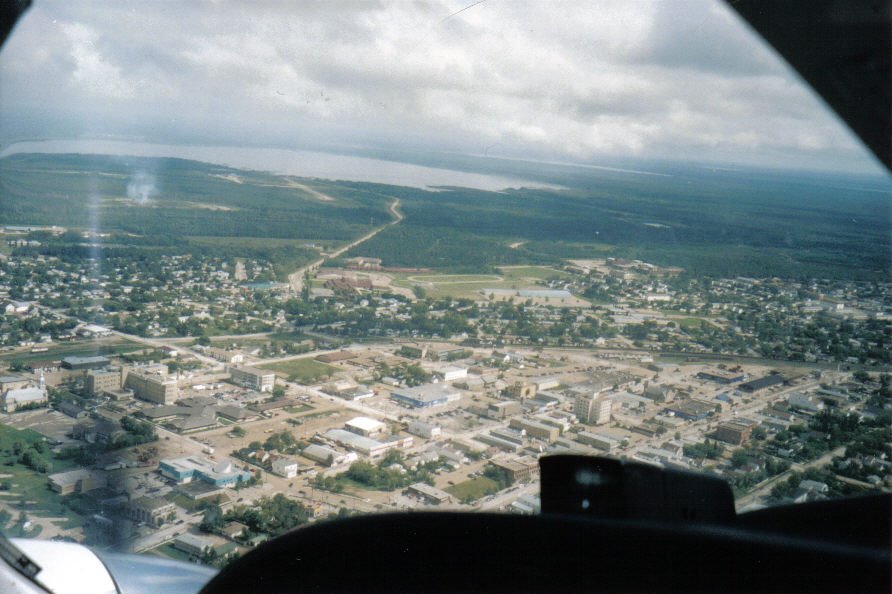
The INCO mine with the City of Thompson in the background

The flying has been going really well. Time has flown by since I started (sorry for the bad pun) as I'm finally doing what I came up here to do. My record of longest time working on the ramp has been broken and there will be guys who will have to do 2full winters loading cargo. I am one of the lucky ones.

Medevacs themselves are very interesting. Not something I'd ever thought I'd be doing. Today we had two trips to two different reserves, both to pick up guys who had had the crap beaten out of them. There are usually more fights right around the 20th and the 1st of the month because that's when the family allowance and welfare cheques come out. More money in town, means more sneaked in booze, meaning more business for Medevacs.

A few weeks ago we had a Medevac from Pukatawagan to The Pas. It was a psych patient so we took along an RCMP officer in case the patient refused to go, that way he could be arrested under the mental health act. This patient actually behaved really well, even said “Please” and "Thank you" when talking to the nurse and RCMP officer. On the way to The Pas, the officer asked if after we dropped off the patient, we'd be able to go visit the jail, as it was their brother in-law's first day. “Sure!” we replied, “is he a guard?” 'No' the officer responded, he's in jail and it's his first day. We weren't quite sure what to say to that, but they still ended up having a nice visit, after which the guards gave us a great tour of the place. I had never actually seen the inside of a jail before. It wasn't too bad, but not a place I'd like to spend any time.

Pukatawagan


The Pas


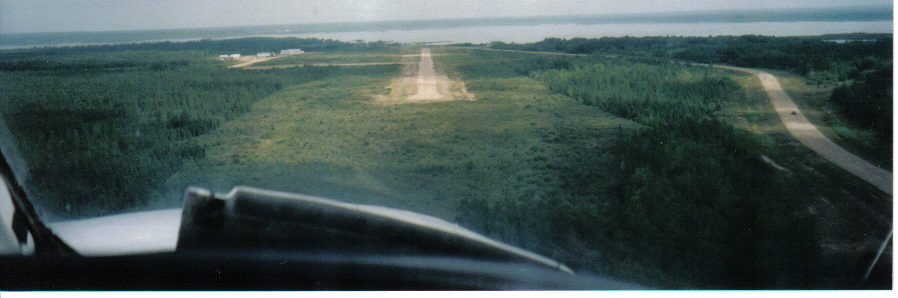
A couple days later, my roommates, Geoff (a Captain) and Paul (a nurse) and I had a midnight Medevac to Shamattawa. It was an overcast night, there were no moon or stars, and it was very dark. Shamattawa is very isolated, a few hundred miles south of Churchill. In October of 2001,on a very similar night, a Perimeter airlines Medevac plane crashed after doing an over shoot on the runway in the 'black hole' conditions killing both pilots and seriously injuring the flight nurse. We made note of this in the pre-landing briefing. As we got closer to the field and switched the runway lights on, we noticed that the front third and last third of the runway lights were working, but the middle lights were all burnt out. We could still see the outline of the runway clearly and decided it was safe to continue on with the approach. The approach was smooth, the winds were quite light so I didn't have a very strong cross wind to fight. Right in the flare, our landing lights revealed why the middle runway lights were out. Some kids had vandalized the runway, smashed the lights and left them and the pylons that hold them right in the center of the runway! Right where I was going to land. We still had enough speed so we were able to hop around them and then come to a stop with a fair amount of room left on the runway. But still, that's not something you are expecting to have to deal with when landing a plane. And really, if you live in an isolated community where airplanes are the only way or in out, do you think vandalizing the runway and possibly causing an accident is a smart idea? Geez, there really are some dumb people in this world, plus I’m willing to bet at some point one of them will have to be Medevac’d out making use of the same runway they vandalized.

Last weekend I had the most exciting Medevac of my career so far. It was already a busy night in at the Thompson hospital as a little girl and her mother were hit by a car while crossing the road. The driver was blinded by the sun and didn't see them until it was too late. Originally, Life Flight, the gov't of Manitoba's jet was supposed to take the little girl, and we were to take the mother. Sadly, the little girl ended up dying from her injuries, so they decided to keep the mother in Thompson for a little while longer. We ended up getting the patient from hell.

This guy, (only 20 years old) was easily about 6'4" 280 lbs and had just got out of prison a week before (not the same one I visited). I guess he tried to go settle some old debts after having lots to drink, but ended up getting the crap kicked out of him. He was found unconscious by the side of the highway. By the time we loaded him on to the plane he still reeked of alcohol even though it had been almost 20 hours since he had been drinking. He was barely conscious, but just to be sure his wrists and ankles had Velcro cuffs on them. He was difficult to get through the door cause he was so tall and quite heavy, however, since he barely had his eyes open we didn't figure he would be much of a problem. We got a quick glimpse of things to come when just before we took off, he bolted himself up to an upright sitting position and started screaming. The nurse settled him down, told him that we were just going to a hospital in Winnipeg and that he should just try and sleep for the trip. The doctor we took along with us didn't even wake up for it (probably because he was narcoleptic). The patient laid back down, and we blasted off for Winnipeg.

After we were about half way there (An hour and a half flight), the patient sat up and started screaming again, he was harder to calm down, the nurse managed to, but only for about ten minutes until this guy started screaming again. We woke up the doctor who went to go help the nurse hold down the patient. The doctor held him down by the C-collar on his neck, but the patient was so strong that he sat up really quickly and broke it. The doctor then held the patient down by his shoulders.. He was screaming and swearing more, and then he started spitting. This was made even more unpleasant when added to the fact that he had lots of cuts in his mouth so his spit was bloody. He managed to hit the doctor with some. The Doctor, a big man and ex Olympic class Judo competitor didn't appreciate being spit on. He then took a blanket and covered the patient's mouth to keep the spit from going everywhere. This may sound harsh, but when you consider the potential for serious communicable disease, I felt the actions were justified. Even still, after everything was done the ceiling of the plane was covered with bloody spit. The doctor didn't want to give him a sedative because we didn't know if he had brain damage or not. About 20 minutes before landing, the nurse said he was having real trouble with the patient trying to get out of his restraints, and unloading him was going to be next to impossible. We called ahead to Winnipeg and asked them to call the police to meet us after landing.

When we arrived, The airport police were waiting for us. We asked if they had any restraints to help unload the patient, but they said they didn't. I asked the maintenance guys that showed up to watch if they had any cargo straps, they said they did and we went to grab them. When the police were told about the spitting patient, they offered to get us a 'spit sock' for him. This is a mesh bag that you put over his face and when he spits, it doesn't go through. It took a bit of time, but once we had the patient herc strapped down, a spit sock on him, 2 pilots, a doctor, a nurse, 4 police officers, 2 paramedics and a bunch of mechanics, we were able to unload the guy. We had breakfast in Winnipeg, flew home, then went to bed, exhausted.

I'm sure I'll have more stories like these as time goes by.

Saturday, December 22, 2007

Back In The Saddle

As some of you may know, I'm not flying commercially at the moment. I had some minor health problems which made flying a whole lot less fun. So, I decided to head back to school a couple of years ago and I'm currently in my second year of law school. If someone decides that a career as a pilot is something that they want to do, I think that it's very important to think about what they'd so if they lost their medical. Having a back up plan in place is key. While I didn't lose my medical, I figured that going back to school was a good idea.

While I love being back at school, it unfortunately isn't exactly a high paying position. Worse still, while I love Halifax, they don't have a flight school really close by. That combined with the fact that there's a lot of work involved with law school (who would have thought?), it had now been 2 years and 4 months since I'd been flying.

It had been too long and I've been getting the flying itch bad.

I booked a check out at the nearest flying school which is unfortunately an hour and twenty minutes away. The staff at Greenwood Flight Centre were great. Getting back up in the air was really great as well, however, it was a humbling experience. I was rusty. But I managed to bring the plane back in one piece and the instructor didn't seem to scared - I have to say though, I thought it was a tad unprofessional when he jumped out and kissed the ground before I had even shut off the engine (kidding).


Friday, December 21, 2007

Air Cargo

I just finished writing a paper on Air Cargo Security and as a result I've been doing a lot of research on the topic. Although I didn't include this in the paper, I remember a story that was told to me by an employee at Air Canada Cargo a number of years ago.

They received a call from a well to do woman who was wondering if they would be able to ship her sailboat's sail from Toronto to Florida. Altough the sail would be rolled up, it was still quite long. The cargo employees checked out the specs for the different planes, at the time, the largest that Air Canada flew to Florida was the 767. They tried different angles, but this sail just wasn't going to fit in the cargo hold.

The cargo employees called her back to tell her the bad news. They couldn't take the sail. Now this wasn't quite good enough for this woman, she paused for a moment and then with an air of authority asked "Well, why can't you just use a roof rack?"

Now in her defence, I suppose it makes sense from her point of view, they use a roof rack for the space shuttle, why not for cargo?

Saturday, December 1, 2007

Back in the Day: Part III

This is the third e-mail that I sent out after starting on the Conquest. It would have been sent out roughly the middle of January 2003:

Being the newest pilot at Skyward, and the lowest seniority F/O (First Officer) on the Conquest, I got stuck being on call for both Christmas and New Year's. However, seeing as I waited for so long to fly, this really didn't bother me.

At first, with the way the scheduling of nurses and planes was going to work out, it looked like I was going to get Christmas day off, then fly a lot for the few days after that. However, everything always changes and at 7:30 pm on Christmas Eve I got a page saying that I was going to have a flight from Thompson to Winnipeg Christmas morning at 6 am and I was to be at the airport at 5:45am. I don't think I've ever gotten up that early on Christmas morning!

We got to the airport and started getting our plane ready, a short while later the nurse showed up with the patient, it was a little girl who had broken her arm and her mother. They were going down to Winnipeg for a specialists appointment. The girl had set up a slide on the edge of her coffee table, then ran and jumped on it, but unfortunately it fell off and she broke her arm. Both the little girl and the mother were apprehensive about flying, so the nurse told them that Captain Steve had been flying for over ten years. Thankfully she left out that First Officer James had been on the job for just over a month! So when I went in to bring the passengers out, the little girl asked (in a really cute voice) "Are you Captain Steve?", "no, I'm James, the co-pilot" I replied. "Oh" she said, sounding really disappointed. "But," I added, "Captain Steve's in the plane right now getting it ready, you'll get to see him really soon." She was happy to hear that. Not the first time a girl had wished I was someone else! :p

The flight to Winnipeg was nice, the radio's were quieter than usual as most airlines had cancelled some flights on Christmas day. All the Air traffic controllers would wish you a Merry Christmas when you changed frequencies and the weather was pleasant as well. We arrived just as the sun was coming up and got a great view of the city, we could just imagine how much wrapping paper was being ripped open at that very minute.

When they had arrived at the airport in Thompson, the mother had brought a big garbage bag full of presents to take down to Winnipeg. They waited in the office for a few minutes while the plane warmed up. Unfortunately she didn't tell either the nurse or myself about it when we got in the plane and the presents got left in Thompson. We didn't discover this until we hadlanded in Winnipeg. I felt pretty bad, although we made sure they made it to Winnipeg the next day, and the girl had already received a few presents, so she was still pretty happy.

Cities on Christmas morning are always nice as they're always deserted. There were very few cars on the road, but it also meant that all the restaurants were closed, we could only find a Robin's Donuts, so we had breakfast there, and when we came back to Winnipeg that afternoon, we had lunch there as well.

I flew on Boxing Day as well. We went to Cross Lake and back twice. We took lots of pictures the first time. The second time we went it was at night and we got an incredible display of the Northern Lights. It was easily the best I have seen before, and Steve who has been flying in the North for almost ten years said it was probably the best he had seen before. I tried taking a picture, but it just didn't do them justice.

I did a few more trips that week. We had a couple of days with pretty bad weather, and flying in them was tricky, but a great learning experience.

On January 5th I went to Rankin Inlet for the second time. I took the scheduled flight up, it was in a Cessna Caravan which is a great plane, but really slow, it was long trip up.

The next day we got a Sanikiluaq - Winnipeg trip. Sanikiluaq is located on the Belcher Islands which are in the southern part of Hudson Bay right near Quebec. Everybody on the radio was speaking french. It's well known for it's carvings of either bone or green rock (not sure what type) so we called ahead and asked the airport radio operator to call some carvers for us. As we landed, the weather started to deteriorate, so I think the carvers decided to just stay home cause no one came out. Oh well. I ended up buying a carving back in Rankin Inlet.


We got back to Rankin late that evening, and didn't end up flying again for 3 days. We had gone out to go take some pictures of the town when we got called on the radio phone that we had a trip to Yellowknife. This was odd, cause we usually don't take patients to Yellowknife from Rankin we take them to Winnipeg, even though Yellowknife is closer. This patient was a psych patient and the mental health center in Winnipeg was full (hmmm, what does that say about Manitobans ? :) so we took him to Yellowknife. The company doesn't fly there very much so it was really interesting to go there. With going to the Northwest Territories, I only have to go to the Yukon and Newfoundland then I have been to all the provinces and territories.

We had dinner at a nice hotel and was surprised to see lots of Japanese tourists. I thought Yellowknife in January was a strange vacation destination. However, it's apparently a fairly popular honeymoon location as the Japanese believe that the Northern Lights are a sign of good luck, and if you conceive a child on a night that the are out, it will bring the child prosperity and luck. (*Note: I have since found out that that is untrue, however, there still were a lot of Japanese tourists) It's for this reason that some hotels in Churchill and Yellowknife have hotel rooms with glass dome ceilings!

When we got back to Rankin there was a full fledged blizzard going on. When a Blizzard hits up there, not a lot of snow falls if any, in fact it's actually considered a desert up in the Arctic. What happens is the winds pick up til they are about 40 mph (70 km or so) and starts blowing all the snow on the ground. You can fly over the airport, look down and see it fine, but once you get quite low the visibility drops. The approach was crazy, the visibility was really low, we saw the runway lights right at minimums and the captain (Jeff) managed a great landing in really strong cross winds.

The blizzard stuck around for a few more days so we ended up staying in Rankin a day longer than normal. We need 1/2 mile visibility to take off and it was 1/8 th of a mile for most of the time. We were on hold for a Rankin Winnipeg trip by this time. So when the weather improved we were to go to leave for Winnipeg. And wouldn't you know, the weather improved, not at a sensible hour say around lunchtime, but at 3 in the morning! So we got a call to pack up all our stuff as quick as possible and hurry to the airport.Within 45 minutes, we were on our way to Winnipeg. We ended up back home in Thompson by about 3 in the afternoon, where I went home and went right to sleep!

I now have about 120 hours on the airplane and have learned an incredible amount of information. I still have lots to learn though. While my regular landings have improved greatly, my cross wind landings aren't very good "Sonny, did we land or were we shot down?" No, that wasn't actually said to me. But I like the challenge of always learning new things and it's satisfying to succeed at things that I've been working on.

Wednesday, November 7, 2007

Back in the Day: Part II

This is the second e-mail that I sent out after I started flying on the Conquest. It was after a one week stint in Rankin Inlet in Dec of 2002. Wow, that seems like a long time ago now!


Skyward has 3 Cessna Conquests. They base one in Thompson, one in Island Lake and one in Rankin Inlet in Nunavut. They crew the planes at the remote bases usually in one week shifts. So, from Dec 8th to Dec 15th I was based in Rankin Inlet in Nunavut territory.

Every Sunday morning, Skyward has a scheduled flight that leaves Thompson at 8am, then makes stops in Churchill, Arviat, Whale Cove and Rankin Inlet. I sat as a passenger and enjoyed the flight. We only made brief stops in each of the communities so I didn't really get time to explore, but it was nice to just sit as a passenger and enjoy the view of Hudson Bay which I was seeing for the first time.

It wasn't my first time in Nunavut. One week earlier I was the First Officer on a flight to Baker Lake. We landed in a Blizzard. Outside it was -30c. With winds gusting to 42 mph, the wind chill was -67c! And I was completely unprepared for it. I didn't have my parka yet, I didn't bring my neck warmer, I didn't bring my heavy duty gloves or my super warm boots; I just had a regular jacket and a hat. I have never been so cold in my life! I got minor frostbite on my cheeks, when the captain noticed frost actually forming on my cheeks he told me to go inside and warm up. Boy did I learn my lesson! The locals found it humorous. Here was this silly kid from Toronto freezing his butt off in a full blown Arctic Blizzard! The taxi driver took pity on me and let me wear his boots for a bit cause they were already warm and I had no heat left in my toes. Although I had never met this person, I had no qualms about wearing his boots cause my feet were so cold!

So this trip up to Nunavut I was prepared, I came equipped with a big $450 Snow Goose parka (the type you see arctic explorers wearing), heavy duty mitts, a really warm hat and my good 'moon' boots (sorels). However, lucky for me when we landed in Rankin it was a balmy -20c, sunny and with no wind. As long as there is no wind, the cold is very manageable if you layer your clothes properly.


We didn't have any trips the first day. For dinner we went over to Jason's (one of our flight nurses who lives in Rankin Inlet fulltime) mother's place where we had an incredible prime rib dinner. The next day Luella and Jana (one of the pilots and the nurse from Keewatin Air) came over to have dinner with us, we hadn't got a call all day, but right as we were sitting down for dinner with them, we got a call for a
Coral Harbour-Churchill trip. We quickly finished some more food, then rushed to the airport. We got to Coral Harbour (on Southampton Island in the North end of Hudson Bay) about an hour and 15 minutes later. We picked up our patient (a woman who had slipped on ice and broken her shoulder) and flew to Churchill. An Ambulance met us at the airport and we went to the hospital. Our nurse Paul had looked at the x-ray and figured there was a pretty good chance this woman would need to go to Winnipeg and have surgery. At the hospital the doctor confirmed this, however, he was unable to find a doctor or a bed for her in Winnipeg. So we waited. A little while later he informed us that he had been able to find a doctor, but still no bed, so we waited some more. We had been waiting for a couple hours when Steve (the captain) decided that we should go to the airport and warm up the plane which had been sitting in the cold with the engines off for a couple of hours now.

After we had warmed up the plane, Paul returned and said that they had not been able to find a bed, so we should just return to Rankin Inlet. So we took off and headed home. We were just over half way back when ATC called us "Skyward 911, I've got some good news for you. Company wants you to return to Churchill." So we turned around and headed back to Churchill. The Ambulance brought the woman out to the airport and we flew down to Winnipeg, arriving just as the sun was rising. By this point we were quite tired and at the end of our duty day, we were not legally allowed to fly anymore.

We checked into a hotel, had breakfast at the restaurant and then went to bed (at 8am). I got about 5 hours of sleep when they decided to start doing bathroom renovations on the floor below me! I went for a walk and then came back and got a couple more hours of sleep.

We left for Rankin at around 5 that evening, the flight back took around 3 and a half hours, once there we put the plane in the hanger and I went back to sleep. I got about 2 hours of sleep when the phone rang for a Repulse Bay - Winnipeg trip. Repulse Bay is right on the Arctic circle on the southern tip of the Melville Peninsula. I crossed the Arctic circle at around 3am that morning. We landed, parked beside a Canadian Forces Twin Otter (I'm not sure what it was doing there) and went into the nursing station to pick up our patient. For some reason, the people are noticeably shorter up there. At 5'10" , I was towering over everybody, plus the ceilings in the nursing station were also really low: so this is what it's like to feel tall!

We flew to Winnipeg, stopping in Rankin Inlet to get gas and arrived in Winnipeg at around 9am. We had breakfast and then checked into the same hotel, I slept like a log, I don't think there was any renovations going on, but if there was, it didn't wake me up. We flew back to Rankin that evening.

On the flight back the sky was very clear and the moon wasn't too bright.We got a magnificent display of the stars, Northern Lights and falling space junk. I'm not sure what the space junk was, but it looked like an incredibly bright star falling from the sky, but it was only a few miles a head of us. Once we arrived in Rankin, we filled up the plane with gas, went home and I slept for the whole night.

Around ten the next morning we got a call for an Arviat-Churchill trip, which ended up turning into a Arviat-Churchill-Winnipeg. Luckily we still had time in our duty day to make it back to Rankin that evening.In 3 days we had flown 26 hours or approximately 13,000 km!

We had one more trip that week from Baker Lake to Churchill.

On Sunday we headed out for the airport for our flight back home, all told we had done about 30 hours of flying in the week and flew enough miles to go to from Halifax to Vancouver and back.

Friday, November 2, 2007

Back in the Day: Part 1

I started writing for fun with e-mails that I sent to friends and family when I started flying up North. Figure a good way to start posts for this blog would be by recapping these e-mails.

Here's the first one from November 2002:

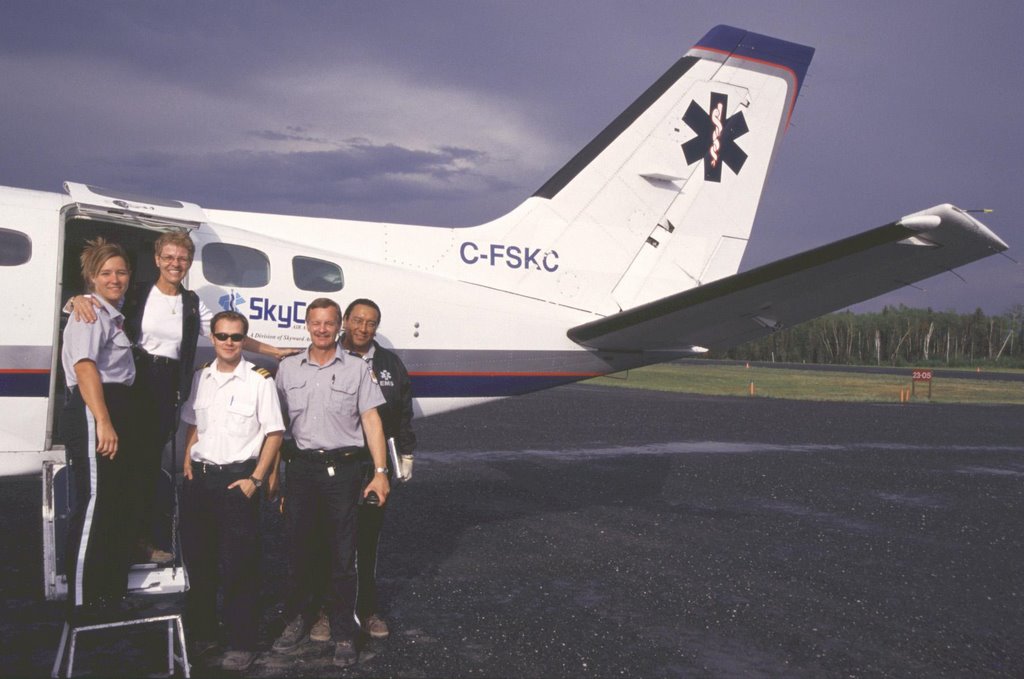
Cessna C441 Conquest II C-FSKG


The last five days have been some of the most intense days of my life. They have been incredibly fun, but the amount of information I have absorbed has been incredible. The training has been like trying to take a drink of water out of a firehose.

I was supposed to start my groundschool on Saturday, unfortunately my training Captain got called out for 2 medevacs that day so we didn't end up doing much. Sunday started off with my first flight. We practiced take-offs, landings, stalls, steep turns and an NDB approach. The Conquest II is a much more powerful plane than anyone I have flown before. The most powerful plane I have flown before had 600 hp, the Conquest has 1271! That has taken a lot of getting used to. Sunday afternoon consisted of 6 hours of groundschool. We went through the majority of the different systems of the aircraft: How the Engine works and it's different characteristics, the electrical system, the hydraulic systems, pressurization and everything else you ever wanted to know about a plane. Monday started with another flight where we practiced a lot of emergencies and engine failures, we even shut down one of the engines in flight! We flew a couple more circuits and practiced some more take off and landings. In the afternoon my training captain had to do another medevac so I went home, slept for a bit and went over some of my notes. We were supposed to do some more groundschool that evening, but instead we did my third and final training flight. We practiced instrument procedures, landing at night, Maximum climb takeoffs (that's where you climb up really quickly and it feels like you're going straight up) and landing without a landing light.

I did some more groundschool on Tuesday and then went on-call Wednesday morning at around 3am. Luckily I didn't get paged until 10:30am. We had a trip from Thompson to Brochet which is a Reserve about an hour's flight northwest of Thompson. We flew out there at FL 220 (22,000 ft) which is more than twice as high than I have flown before. I was the pilot flying and Geoff (the captain) worked the radios, except Geoff did the landing in the reserve cause it's a shorter runway. We landed at Brochet where a pick-up truck met us and took myself, Geoff and the flightnurse to the nursing station. A woman had hurt her back in a snowmobiling accident. We waited around the nursing station for a bit while the nurse got all the stats about the patient. We then put her on a strecther and loaded her into the back of the pick up truck and went back to the airport. We had to sit in the back of the truck with the patient. Although it was sunny, it was the end of November in Northern Manitoba and we were on a dirt road: It was crisp and the ride was bumpy. Once at the airport, we loaded the patient on the plane and flew back to Thompson, this time I worked the radios and Geoff flew. Once in Thompson we were met by the ambulance who took the patient to the hospital.

We had just been back in Thompson for about 15 minutes when the pager went off again. Once the nurse got back from the hospital we were to take a little baby and her parents to the children's Hospital in Winnipeg. Geoff and I had lunch at the airport restaurant and then once the nurse came back from the hospital in Thompson with the family, we blasted off for Winnipeg. We flew down to Winnipeg at 17,000 ft cause we wanted to keep the cabin altitude nice and low, the baby just slept most of the way, it was really well behaved and didn't cry at all. We came into Winnipeg after it had just gotten dark, we flew right over downtown and then followed a WestJet 737 on final approach. We landed in Winnipeg, parked beside two Challenger Jets, and were met by another ambulance who took the nurse and the family to the children's hospital. Geoff and I waited around the airport for a little while then took the company van and picked the nurse up from the hospital. After we picked up the nurse, it was off to Polo Park mall for some dinner. After dinner we went back to the airport and flew back to Thompson. It was my leg to fly and we had a strong 75kt headwind the whole way back so it took us a while. Once you get about 200km north of Winnipeg, all the lights end and it gets really dark, you have to follow your instruments cause you can't see anything. I landed in Thompson, not one of my better landings, but the plane's still in one piece :) Taxiied in, and shut down. Our duty day only had a few more hours in it so if there was another call, the other crew would most likely get it.

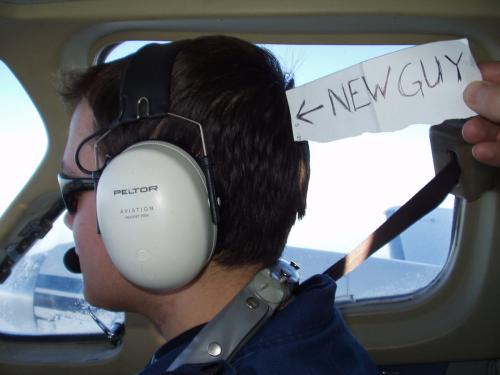
Me at the End of my First Day 'On The Line'