Saturday, December 1, 2007

Back in the Day: Part III

This is the third e-mail that I sent out after starting on the Conquest. It would have been sent out roughly the middle of January 2003:

Being the newest pilot at Skyward, and the lowest seniority F/O (First Officer) on the Conquest, I got stuck being on call for both Christmas and New Year's. However, seeing as I waited for so long to fly, this really didn't bother me.
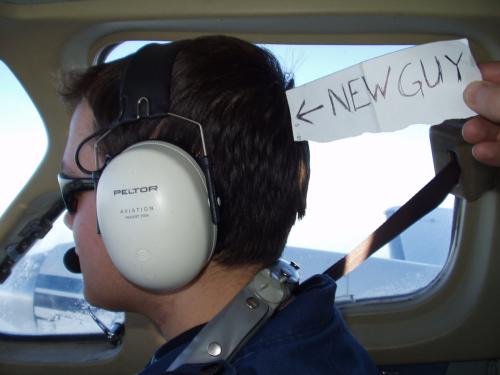
At first, with the way the scheduling of nurses and planes was going to work out, it looked like I was going to get Christmas day off, then fly a lot for the few days after that. However, everything always changes and at 7:30 pm on Christmas Eve I got a page saying that I was going to have a flight from Thompson to Winnipeg Christmas morning at 6 am and I was to be at the airport at 5:45am. I don't think I've ever gotten up that early on Christmas morning!

We got to the airport and started getting our plane ready, a short while later the nurse showed up with the patient, it was a little girl who had broken her arm and her mother. They were going down to Winnipeg for a specialists appointment. The girl had set up a slide on the edge of her coffee table, then ran and jumped on it, but unfortunately it fell off and she broke her arm. Both the little girl and the mother were apprehensive about flying, so the nurse told them that Captain Steve had been flying for over ten years. Thankfully she left out that First Officer James had been on the job for just over a month! So when I went in to bring the passengers out, the little girl asked (in a really cute voice) "Are you Captain Steve?", "no, I'm James, the co-pilot" I replied. "Oh" she said, sounding really disappointed. "But," I added, "Captain Steve's in the plane right now getting it ready, you'll get to see him really soon." She was happy to hear that. Not the first time a girl had wished I was someone else! :p

The flight to Winnipeg was nice, the radio's were quieter than usual as most airlines had cancelled some flights on Christmas day. All the Air traffic controllers would wish you a Merry Christmas when you changed frequencies and the weather was pleasant as well. We arrived just as the sun was coming up and got a great view of the city, we could just imagine how much wrapping paper was being ripped open at that very minute.

When they had arrived at the airport in Thompson, the mother had brought a big garbage bag full of presents to take down to Winnipeg. They waited in the office for a few minutes while the plane warmed up. Unfortunately she didn't tell either the nurse or myself about it when we got in the plane and the presents got left in Thompson. We didn't discover this until we hadlanded in Winnipeg. I felt pretty bad, although we made sure they made it to Winnipeg the next day, and the girl had already received a few presents, so she was still pretty happy.

Cities on Christmas morning are always nice as they're always deserted. There were very few cars on the road, but it also meant that all the restaurants were closed, we could only find a Robin's Donuts, so we had breakfast there, and when we came back to Winnipeg that afternoon, we had lunch there as well.

I flew on Boxing Day as well. We went to Cross Lake and back twice. We took lots of pictures the first time. The second time we went it was at night and we got an incredible display of the Northern Lights. It was easily the best I have seen before, and Steve who has been flying in the North for almost ten years said it was probably the best he had seen before. I tried taking a picture, but it just didn't do them justice.

I did a few more trips that week. We had a couple of days with pretty bad weather, and flying in them was tricky, but a great learning experience.
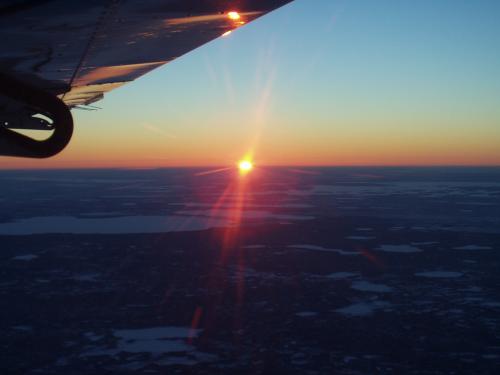
On January 5th I went to Rankin Inlet for the second time. I took the scheduled flight up, it was in a Cessna Caravan which is a great plane, but really slow, it was long trip up.

The next day we got a Sanikiluaq - Winnipeg trip. Sanikiluaq is located on the Belcher Islands which are in the southern part of Hudson Bay right near Quebec. Everybody on the radio was speaking french. It's well known for it's carvings of either bone or green rock (not sure what type) so we called ahead and asked the airport radio operator to call some carvers for us. As we landed, the weather started to deteriorate, so I think the carvers decided to just stay home cause no one came out. Oh well. I ended up buying a carving back in Rankin Inlet.
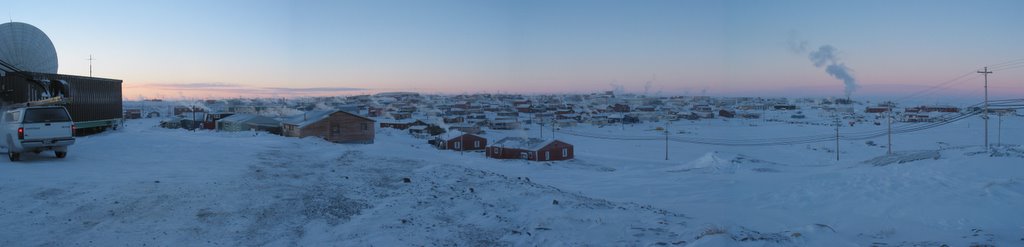

We got back to Rankin late that evening, and didn't end up flying again for 3 days. We had gone out to go take some pictures of the town when we got called on the radio phone that we had a trip to Yellowknife. This was odd, cause we usually don't take patients to Yellowknife from Rankin we take them to Winnipeg, even though Yellowknife is closer. This patient was a psych patient and the mental health center in Winnipeg was full (hmmm, what does that say about Manitobans ? :) so we took him to Yellowknife. The company doesn't fly there very much so it was really interesting to go there. With going to the Northwest Territories, I only have to go to the Yukon and Newfoundland then I have been to all the provinces and territories.

We had dinner at a nice hotel and was surprised to see lots of Japanese tourists. I thought Yellowknife in January was a strange vacation destination. However, it's apparently a fairly popular honeymoon location as the Japanese believe that the Northern Lights are a sign of good luck, and if you conceive a child on a night that the are out, it will bring the child prosperity and luck. (*Note: I have since found out that that is untrue, however, there still were a lot of Japanese tourists) It's for this reason that some hotels in Churchill and Yellowknife have hotel rooms with glass dome ceilings!

When we got back to Rankin there was a full fledged blizzard going on. When a Blizzard hits up there, not a lot of snow falls if any, in fact it's actually considered a desert up in the Arctic. What happens is the winds pick up til they are about 40 mph (70 km or so) and starts blowing all the snow on the ground. You can fly over the airport, look down and see it fine, but once you get quite low the visibility drops. The approach was crazy, the visibility was really low, we saw the runway lights right at minimums and the captain (Jeff) managed a great landing in really strong cross winds.

The blizzard stuck around for a few more days so we ended up staying in Rankin a day longer than normal. We need 1/2 mile visibility to take off and it was 1/8 th of a mile for most of the time. We were on hold for a Rankin Winnipeg trip by this time. So when the weather improved we were to go to leave for Winnipeg. And wouldn't you know, the weather improved, not at a sensible hour say around lunchtime, but at 3 in the morning! So we got a call to pack up all our stuff as quick as possible and hurry to the airport.Within 45 minutes, we were on our way to Winnipeg. We ended up back home in Thompson by about 3 in the afternoon, where I went home and went right to sleep!

I now have about 120 hours on the airplane and have learned an incredible amount of information. I still have lots to learn though. While my regular landings have improved greatly, my cross wind landings aren't very good "Sonny, did we land or were we shot down?" No, that wasn't actually said to me. But I like the challenge of always learning new things and it's satisfying to succeed at things that I've been working on.

Wednesday, November 28, 2007

The Airline Transport Licence - ATPL

I received a comment from reader who will be starting their flight training shortly. Overall the comments about the book were very positive although they had a question about the ATPL:

The only subject that I still have some questions about is the ATPL, in your book you described in detail every license except that one... I've heard there's no actual in-flight exam to obtain the ATPL but how does a pilot end up obtaining it? Lets say i get a CPL and a job... will the airline finance the ATPL and make sure i pass the exam or once I work up the hours I go to another FTU and pass the ground school + written exam...
That what my only question.


When writing the book, I thought about putting the information regarding the ATPL into a section but instead just briefly mentioned it. At the time I figured that this would be information that student pilots wouldn't need to know for a number years and they'd pick up the information as they progressed through the industry. In retrospect, I should have included a section on it. Although it is true that as a student pilot you don't really need to know about the requirements for at least a couple of years after you've been flying, it's always a good idea to know what you're getting yourself into.

THE ATPL
The ATPL is a different type of licence than most of the other licences. You're required to have it to act as PIC of a two crew aircraft. You can act as a co-pilot of a two crew aircraft if you have the ATPL, have passed the written exams but not met the hour requirements, or if you have a CPL and have passed the IATRA. Another test.

As you mentioned, there is no actual flight test. What is required is that you have to be over 21 years of age, have passed the two written exams within the past 2 years, and have passed a Group 1 (multi-engine) instrument rating within the past year upon meeting the hour requirements and passing the written exams. This can also be done in a Aircraft check ride or type rating flight test which usually will renew a Multi - IFR.

The magic number is 1500 hours. But keep in mind that towards this licence, you can only count half of your co-pilot time. So if you've got 600 hours as a co-pilot, you can only count 300 of those hours towards your licence.

Other hour requirements include:
-900 of those hours must be in an airplane
-250 hours PIC
-100 hours PIC cross-country
-25 hours PIC night, cross-country
-100 hours of night flying
-75 hours instrument time (max 25 in a sim)

When you have approximately half the time required for the licence, you're allowed to write the two written exams:

-The SAMRA which tests Meteorolgy, Radio Aids to Navigation and Flight Planning and,

-The SARON which tests Air Law, Operations and General Navigation

Each of the exams are 3.5 hours long, mulitple choice and you require greater than 70% to pass and are valid for 2 years (i.e. if you don't get meet the hour requirements within two years after writing these exams, you ahve to take them over).

You also have to have your Instrument rating exam passed and not expired.

There isn't a specific ground school requirement for the ATPL. However, there are a number of courses put on for refreshers. Also, there are a few different sample study guides which pilots will study for.

What will normally happen when you're in the industry is that you'll co-ordinate with your airline for a few days off to write the exam. Most people that I know general write one, and then the other a couple months later but it's not unheard of to write both in a row. You'll usually have to pay for the written exams yourself.

The flight test however will usually just be a type rating or PPC renewal with your airline which they should be paying for.

There is a special section in the hours requirements for PIC time. If pilots are flying as co-pilots for an airline that only operates larger aircraft where it is not possible to get PIC time without having an ATPL, they have the potential of gaining 100 of their PIC hours under the 'PIC under supervision' provision. This needs to be worked out directly with the airline though.

Saturday, November 24, 2007

So, You Want to be a Regional Airline Pilot

This was a video that has been up on YouTube for a few years now. It was done during a time of cut backs in the industry, likely by a pilot who was petty fed up with the way things were going. Basically, this video outlines the low salaries at the entry level positions for the regional airlines in the US.

These salaries are low. In relation to the last post, it's important for new pilots to understand that things can be a pretty tough go at first and that you won't be starting on a Boeing or Airbus directly after finishing Flight School.

There are a number of things to keep in mind though:

1- In Canada, although at the lower levels of the industry salaries are quite low, they're not as bad as the ones listed in the videos. I discuss average salaries at different levels of the industry my book.

2- The salaries listed at the time were for the first year junior F/O position. These salaries will go up as you gain experience. Interested pilots should check out www.airlinepilotcentral.com for salaries of each of the airlines.

3- The salaries don't necessarily consider the 'per diems' provided for new pilots.

4- This video was done at a time when major airlines were not hiring. Although the situation for pilot hiring in the US is not as good as the rest of the world, the economics of supply and demand will dictate what airlines have to pay to keep pilots. A few years ago there were a number of out of work pilots in the US and many airlines were doing very poorly financially, so they paid these low salaries.

5- Nonetheless, paying attention to the salaries are important. It's my hope that pilot salaries will begin to moderate themselves. While the highest salaries may not be quite as high, the lower salaries won't be as low.

On the plus side, I was talking with a a former co-worker who now flies for Air Canada. Currently he's an Airbus A320 F/O and he's on salary making $42,500 a year. In a couple of months however, he switches to formula pay. That will pretty much double his salary. He's not going to be rich anytime soon, but airline pilot salaries can be quite comfortable after a couple of years.

So, while I think that new pilots should be aware of the pay at different levels of the industry, I don't think it's necessary to be quite as jaded as the producer of the video.

Friday, November 23, 2007

Global Pilot Shortage a Looming Crisis

With a strong World Economy and the demographics of aging baby boomers, industry insiders seem to be suggesting that this global hiring boom will be creating a possible global pilot shortage in the near future.


Global pilot shortage a looming crisis in Canada
Pilots complain 'magic' of flying has faded with no-frills airlines, low salaries
Last Updated: Wednesday, November 21, 2007 | 10:31 AM ET
CBC News


While airlines are filling their planes with passengers, the struggle to keep their pilots in the cockpits is a deepening crisis in the global air travel business, aviation experts are saying.

shortage of commercial pilots flying the skies above Canada and the world over is so serious that the International Civil Aviation Organization predicts at least 15,000 new pilots will be needed every year in the next two decades. Canada and the U.S. will need at least 60,000 new pilots by 2020.

For Canadians, massive retirement, competition from the air force and foreign airlines, and low salaries are among the factors contributing to a general fading of the romance of the skies.

Flight classes at the Algonquin Flight Centre in North Bay, Ont., still have too many vacant seats, the school's owner, Stefan Corriveau, told CBC News.

Corriveau said that an airline in the U.S. last month had to cancel four per cent of its flights because no flight crews were available. He worries for the future of pilots at home.

"I think those problems will come to Canada," he said.

Although Corriveau said he knows he can handle more students to train for the major airlines, he said the flight business has lost its appeal to a younger generation discouraged by low starting salaries and sky-high training costs.

'Salaries are way too low'

"The salary issue is a very sensitive issue for a lot of pilots and in Canada right now, the opinion of many is that the salaries are way too low," he said.

To earn the minimum license required by commercial airlines at similar flight schools, students such as Bill Tompkins have to pay as much as $60,000, while starting salaries often barely crack $30,000.

"With the advent of low-fare airlines, really you've just become a glorified bus-driver," Tompkins said. "They've just cheapened it. For me, it's still there — there's a bit of magic, but the romance of flying is gone."

Travis Griffin graduates next year from the school, but he'll return to his native Ireland to work, where he can make a more comfortable living.

"It's 50,000 to 60,000 euros to start off, and then you get benefits on top of that, so it's better at home," Griffin said.

European and Asian airlines flush with cash are also coming to Canada and luring away home-grown pilots.

Air forces want to retain pilots
The military, meanwhile, is working hard to retain the young pilots it has trained in the air force. Before Jack Desmarais retired after decades of flying 747s for Air Canada, he began his career in the military. Many of his colleagues also learned their skills in the air force before later turning commercial.

But now, air forces around the world are giving better financial incentives to keep their pilots in uniform.

CBC workplace specialist Frank Koller said baby boom pilots are also retiring quickly, and that the airline industry has still not recovered pilots who left after the economic turmoil immediately following the Sept. 11, 2001, attacks in the U.S.

He said some airlines, such as Air Canada Jazz, are trying to curb the pilot shortage by taking young pilots fresh out of flight school and mentoring them on the job in the cockpits. Although there are safety concerns, Koller noted that it's been done for years in Europe.


This article raises a number of key issues, some of which are addressed in my book.

The Pilot Shortage - I started my training in 1999. At that point, there was a strong economy and airlines were doing lots of hiring. When I graduated from college, things started slowing down and Sept 11th, 2001 caused a massive drop in demand for air travel.

Prior to this however, every flight school you talked to was predicting a pilot shortage. Things were going to be just like the good old days in the 1970s when Air Canada hired pilots right out of flying school. In fact, my uncle started with Air Canada at age 21 as a second officer on an L1011.


I was and still am sceptical that this will happen again. While I think hiring will be strong for the forseeable future, pilots will still ahve to find way to gain experience and hours. This brings us to the next issue:

Airline Cadets - Air Canada Jazz has a trial project this year. They took the top few graduates from a number of Aviation Colleges and put them through Ground School. If they passed all the required training, they will possibly qualify as junior first officers. This has sparked a bit of an uproar in the pilot community as a number of more experienced pilots who have been by-passed feel that these younger piots should have to 'pay their dues' and gain experience.

Cadet programs are used in Asian and European airlines. In a number of airlines, the First Officer of your Boeing or Airbus could be in her early 20s and only have a couple hundred hours. I think with the right amount of training this can avoid safety issues, but I am a proponent of gaining 'real world' experience. In the few years that I was flying professionally I learned a lot.

Low Salaries / Working Conditions - This is another difficult issue. Aviation is different today than it was a few decades ago. Passengers expect low airfares and with rising fuel costs, profit margins are getting thinner. If airlines raise salaries, they'll have to increase ticket prices which will likely lower passenger demand, however, if they don't raise salaries more and more people are going to choose other professions.

In my book I outline the general remuneration that pilots make at different levels of the industry. I think in general, many pilots sacrifice in the beginning making a low salary so that they will gain the experience to make a higher salary, infact, some newer pilots will even fly for free (Do NOT do this as I outline in the book).

Newer pilots should be aware of the general salary trends so that they have a good idea of what to expect in the industry. Jobs at airlines can be relatively well paying, but you're not going to be filthy rich.

Wednesday, November 21, 2007

Al's First Year

Here's a video by my former Co-worker Al documenting his first year 'flying the line' on the Metro with Perimeter Airlines out of Thompson Manitoba.

Saturday, November 17, 2007

University of Waterloo Aviation Programs

In my book, I have a listing of College and University Aviation Programs across Canada. These programs can change a fair bit from year to year and unfortunately one slipped under the radar. The University of Waterloo in Waterloo, Ontario has two new aviation degree programs: A Geography and Aviation Degree and a Science and Aviation Degree. This program commenced in September 2007 and is run in conjunction with Waterloo Wellington Flight Centre.

More information can be found at: University of Waterloo Aviation

Here's an article from Waterloo's alumni magazine. One thing to keep in mind is the cost of this program. The alumni magazine suggests that Flight Training costs will be roughly $50,000 and this is on top of the regular estimated $25,000 University costs. Plus, Waterloo Airport is relatively far from the University of Waterloo Campus so you'll likely need to have access to a car - there is no public transportation that goes to the airport. So while it would be very beneficial to receive university credits for your flight training, the cost of this program is quite high.


New aviation degree offered with science and geography programs

Aviation enthusiasts will be able to learn to fly while earning a university degree through two new programs offered by the University of Waterloo.

A new bachelor of environmental studies degree in geography and aviation as well as a new bachelor of science in science and aviation will take flight starting September 2007. Recently approved by UW's senate, both programs were developed in partnership with the Waterloo-Wellington Flight Centre (WWFC).


"The field of aviation has evolved significantly over the past 50 years," said Morton Globus, a professor emeritus in the faculty of science and key developer of the new programs. "Aviation and aerospace industries demand a new breed of specialists who have a comprehensive academic background to help them understand complex aircraft systems and well-developed analytical, critical thinking and decision-making skills."


Professor Emeritus Morton GlobusToday, flight training is a requirement for many aviation and aerospace careers. A university degree, meanwhile, is seen by the airline industry as a valuable asset for a pilot and is rapidly becoming a requirement for the profession.

To meet that need, UW's new programs provide a solid foundation for careers in a diverse range of aviation and aerospace industries.

Both degrees are designed to provide candidates with a comprehensive grounding in aviation-relevant subjects such as geomatics (science and technology of gathering, analyzing, interpreting, distributing and using geographic information), climatology, cartography and remote sensing.

Globus, a pilot himself and UW's liaison with WWFC, said the programs are unique in Canada. "Waterloo has a very strong science, environmental science, geomatics and technology base that will provide many of the essential underpinnings of aviation and aerospace," he said.

In UW's faculties of environmental studies and science, aviation-related areas include solid-state physics, wireless communication, astrophysics, energy cells, fuels, remote sensing, climatology/meteorology, environmental sciences, computer cartography, geomorphology, global positioning systems and geographic information systems, among others.

The aviation component of both programs will cover professional pilot program requirements, delivered by WWFC. The WWFC, a non-profit organization established in 1932, has been offering flight training for more than 70 years and is widely respected in the Canadian aviation industry.

The new programs will cost about $50,000 for flight training, on top of about $25,000 in tuition fees over four years.

Written by John Morris
UW Media Relations


Friday, November 16, 2007

Thank Goodness For TCAS

Modern Airliners are equipped with a device called a Traffic Collision and Avoidance System or TCAS for short. It's actually an amazing system that alerts pilots to the presence of other planes that could cause the potential for collision. The more advanced versions of TCAS even allow the systems in each plane to 'talk' to each other. If there is a potential for a collision, the system on one plane will tell it to climb whereas the system on the other plane will tell it to descend - thus avoiding a collision.

A TCAS display - the diamonds are other aircraft

In fact, today pilots are taught that no matter what your Air Traffic Control Clearance is, if the TCAS tells you to do something, you follow its commands. There was a tragic accident in 2002 where a controller told an aircraft to descend whereas the TCAS told it to climb. The pilot followed the controller's instructions which led to a mid-air collision.

The other day over Indiana, there was a near miss. This time however, both pilots followed the TCAS instructions and everybody was ok.


Cockpit device narrowly averts collision

Controller error undone by cockpit alert over Indiana
By Jon Hilkevitch | Tribune transportation reporter
November 15, 2007

A Chicago-bound jet came within seconds of a midair collision at 25,000 feet over Indiana, but a cockpit safety device alerted the pilots flying the other plane of the danger ahead, officials said Wednesday.

The near collision Tuesday evening was attributed to an error by an air-traffic controller who directed an eastbound Midwest Airlines plane to descend into the path of a westbound United Express jet, according to a preliminary investigation by the Federal Aviation Administration.

The controller, a 26-year veteran, appeared to have forgotten about the United Express plane after he mistakenly removed its electronic identification tag from his radar screen in preparation to hand off the plane to controllers in a different air sector, officials said.


The incident occurred "on the tail end of a rush" amid a shift change at the Chicago Center radar facility in Aurora, said FAA spokeswoman Elizabeth Isham Cory.

It was the latest in a series of serious errors since Oct. 1 at the FAA center, where tensions are high between the controllers union and management over adequate staffing levels.

The near collision occurred near Ft. Wayne, Ind., as the two regional aircraft closed in on each other at a combined speed of more than 700 m.p.h. -- or about 12 miles every minute, officials said.

The jets' speeds normally would have been even faster, but traffic in the airspace was slowed by congestion at O'Hare International Airport, where the United Express plane, carrying 28 passengers, two pilots and a flight attendant, was heading from Greensboro, N.C.

Tragedy was prevented when a collision-avoidance alert sounded in the cockpit of the Midwest plane, carrying 21 passengers, two pilots and a flight attendant from Milwaukee to Dayton, Ohio. The pilots executed an emergency climb to steer clear of the other plane, officials said.

"If they didn't suddenly climb, there would have been a convergence," said Midwest spokeswoman Carol Skornicka.

On radio communication tapes, the pilots mentioned three times how close the planes came to one another, said Jeffrey Richards, president of the National Air Traffic Controllers Association at Chicago Center.

"Center, you really lined us up on that last clearance," Richards quoted one of the pilots as saying.

The two aircraft came as close as 1.3 miles from each other horizontally and 600 feet vertically, the FAA said. The minimum separation permitted is 5 miles horizontally and 1,000 feet vertically.

"The controller at first did identify the potential conflict and took action" to stop the descent of the Midwest plane, Cory said. "However, it's still to be determined why, within less than a minute, he then dropped the data block [from his radar screen] and continued the descent."

The controller error marked the third serious mistake in only six weeks by controllers at Chicago Center, which handles high-altitude traffic over portions of the Midwest. Only one error of such magnitude occurred within the previous 12 months at the radar facility, officials said.

On Tuesday night, controllers on average worked close to the two-hour limit on their radar positions between rest breaks, Richards said.

"These controllers are fatigued from working such long stints and very few breaks compared to just three years ago," said Richards, who contends that a wave of retirements is draining the FAA of seasoned controllers.

Richards said the controller who committed the error was nearing the end of his shift and had returned from a break just several minutes earlier.

"Each of his sessions were right up to the two-hour limit," Richards said.